This is an old revision of the document!
Table of Contents
Report
Title: Aquaponics System
Authors: Natalia Sokolowska • Arlene Docherty • Anna Mesas Llauradó • Sean Keane • Gwénaël Méry
Acknowledgement
Glossary
| Abbreviation | Description |
|---|---|
| EPS | European Project Semester |
| ISEP | Instituto Superior de Engenharia do Porto |
| USB | Universal Serial Bus |
Chapter 1: Introduction
1.1. Presentation
We are a group of 5 international students. At the end of February 2014 we started a program called the European Project Semester at the Instituto Superior de Engenharia do Porto. During the european semester we will work on a project lasting whole semester and we will participate in the complimentary classes.
Table 1 - Team members

1.2. Motivation
As a group we came to an early decision that we would like to choose a proposal that incorporated sustainable techniques and been eco-friendly, as this is the future of all Design/Engineering. As a group we were all interested in creating our own Aquaponics system as this is a system/technique that is becoming ever more popular throughout the world, more so in poorer regions and where water is a limited resource.
1.3. Problem
We were tasked with designing and building an Aquaponics system that supports both fish and plant culture without the use of soil and supported by water recirculation. The system must be as sustainable as possible. From this, our idea’s focussed on the sustainability of the system. We decided to target the household market as a small system would be easier to control and keep sustainable compared to a large (small farm) sized system. This system would also allow us to create an aesthetic product that would sit within the home. Even though there are many Aquaponics systems in use at a large scale there are not many for use within the home and this is why our market was targeted towards this area.
1.4. Objectives
The main objective of the project is to create a working system as to support both fish and plant culture. The system must be able to be monitored so that optimum conditions are in place. This would mean using sensors to check temperature and other parameters. In order to fulfill the secondary objective of being as sustainable as possible we must look to use as little power as possible and be efficient when using the water recirculating so more water does not need to be inputted into the system. To use materials that have been recycled or reused as to be sustainable in creating the prototype.
1.5. Requirements
There are a number of requirements needed to be fulfilled for the Aquaponics project to work correctly. First of all it needs to be as much sustainable as it is possible. To achieve this we need to pay attention to the structure of the system: the water must recirculate and the amount of energy input to the system should be kept to a minimum. Secondly, our prototype must be easy to control. Therefore users of our Aquaponics system must be able to monitor parameters such as temperature, flow, conductivity, pH or dissolved oxygen. Moreover, due to the target we have chosen, which is the domestic use of our prototype, it requires having an attractive design. Furthermore, the project obligation is to reuse provided components or low cost hardware solution which we must take into account when constructing our system. Also it is necessary to use open source and free software and technologies.
1.6. Functional Tests
1.7. Project Planning
The work plan and the Gantt Chart were created. We divided the whole project into smaller parts and created the list of the tasks we need to complete. Afterwards, we allocated each task to the team members according to their skills and knowledge (Table 1). Next, in the Gantt chart we specified details of each task and dates to perform it.
| Task | Responsible |
|---|---|
| The project and background information | All |
| Search components and materials | All |
| Marketing plan | Natalia |
| Development of the acquaponics system (plants, fish…) | All |
| Design | Sean and Anna |
| Interim report | All |
| Communication | Arlene and Sean |
| Ecological footprint and sustainability | Gwen and Sean |
| Ethical and deontological concerns | Anna |
| Project Development | All |
| Final report | All |
| Final presentation | All |
| Video, paper and poster | All |
| User manual and leaflet | All |
1.8. Report Structure
The report is structured into 8 major chapters and a couple minor sections.
Chapter 1 – Introduction: Present Team; Project; Objectives; Motivation; Problems and Results we hope to achieve.
Chapter 2 – State of the Art: Describe Aquaponics and compare current systems already on the market.
Chapter 3 – Project management: How to manage a project to work in a good way.
Chapter 4 – Marketing Plan: Use Market analysis to find Target market and Product placement.
Chapter 5 – Eco-efficiency Measures for Sustainability: Consideration of Social, Environmental and Economic Impact of System.
Chapter 6 – Ethical and Deontological Concerns: Reflection of different codes of Ethics upon our Product and the Market.
Chapter 7 – Project Development: Description of Design and Development of System as a Functional Product/Prototype.
Chapter 8 – Conclusion: Summary of report as a whole.
The Minor Sections include: The acknowledgement; The Glossary; The Bibliography and References.
Chapter 2: State of the Art
2.1. Introduction
The aquaponic is based on productive systems that can be found in nature. It can be described as the combination of the aquaculture and hydroponic and this is where the name comes from: aqua-ponic.
Hydroponic systems rely on the use of nutrients make by humans for optimum growth of plants. Nutrients are manufactured from a blend of blend of chemicals, mineral salts and trace elements to form the 'perfect' balance. Water in hydroponic systems must be discharged periodically, so that salts and chemicals do not accumulate in the water that could become toxic to plants.
Aquaculture systems focus on maximizing the growth of fish in ponds. Fish are usually crammed into ponds, it is not uncommon to have a density of 10 kg of fish per 100 l of water. High densities of breeding often mean that water from the reservoir becomes polluted by effluent from fish that produces high concentrations of ammonia. The water must be drained off at a rate of 10-20% of the total volume of the basin, once per day, every day. This water is often rejected directly wilderness where it pollutes and destroys natural resources.
The aquaponic combines the two systems in a symbiotic environment. It can cancel the negative aspects of each. Instead of adding toxic chemicals solutions to cultivate plants, the aquaponie uses highly nutrient effluent from fish that contain virtually all the nutrients needed for optimum growth of plants. Instead of discharging water, theaquaponie uses plants to cleanse and purify the water, after which the water is back in the aquarium. This water can be re-used indefinitely and must be replaced when it evaporates.
2.2. Functioning
2.2.1 The nitrogen cycle
Invisible essential to an aquaponics system is the benefit of bacteria. Bacteria thrive in the dark gravels of culture beds and Breeze elements in the water in a form that plants can absorb and use. An aquaponics system is organic by nature. Synthetic fertilizers may not be given in food plants without risk of harm to fish and beneficial bacteria, the system must be maintained naturally. There are two different bacteria that break down fish waste, the first is the Nitrosomonas, that convert ammonia to nitrite. These nitrites are then converted to nitrate by Nitrobacter bacteria, plants can then consume nitrates and grow.

2.2.2 Simple example
It is in fact a near Self Sustaining Ecosystem which requires minimal input and includes live bodies within an ecological cycle.
- Fish are fed and produce excrement rich in nitrogen (ammonia NH3 and urea), phosphor and potassium. This excrement is the source of nutrients for the plants. Food given to the fish is put back into the water in the form of fertilizer (excrement) but the ammonia is toxic for the fish. We must filter the water to reduce/rid of the ammonia so the fish will survive.
- The water of the tank is pumped and sent to the tubs of culture where plants/vegetables are grown in a neutral substratum expanded clay balls. Complex natural reactions are set up alone: Bacteria transforms ammonia into nitrites then nitrates.
- Plants can use the nitrates and absorb them by their roots.
- This produces a natural filter which clears the water of its toxic components.
- The clean water is sent back to the tank.
- The water on return will at one point be open to the air to oxygenate it (this oxygen will be useful for the fish, plants and bacteria).

2.3. Components
There are basic components that every Aquaponics system will need, regardless of the type of Aquaponics system we set up. There can be some variation in what we actually use for each component, usually dependant on how much money we want to spend. we will need the following for an Aquaponics set-up.
2.3.1. Fish Tank
We can use an aquarium, a pond/pool, a used food-grade container, a barrel/drum; basically anything that will hold water and can hold fish without being poisonous to the fish. The size we need will be dependent on the amount of fish we are going to keep and whether we want them as an integral part of the system or to grow out as food.
2.3.2. Grow Beds
What we use will be determined by the type of system we set up, so we will decide once we know what system set up we are using. There are three types of Aquaponics systems: media-based, NFT and deep water/raft. Depending on the system, we could need rain guttering, half barrels, Styrofoam sheets, PVC pipe/channels, buckets/plastic containers. The depth of these can range between 5-30cm to hold enough growth media to allow the plants to grow.
2.3.3. Growing medium
Again, this will be determined by the type of system we have. Aquaponics systems do not use soil so we need to have something else to support the plants as they grow as well as hold some water, if we are using a media-based system.
2.3.4. Pump
A water pump is needed to circulate the water from the fish tank through the grow bed and back to the tank.
2.3.5. Tubing
Tubing is needed to carry the air and water through the system. Water pumps generally use half inch tubing while air pumps are set up for quarter inch tubing. Plastic tubing is available in both clear and black; black tubing deters algae from growing and clogging the tube. Drip irrigation systems use quarter inch tubing and this is very good for Aquaponics; it is very durable and cheaper than what is available in aquarium supply stores.
2.3.6. Timer
Some systems require a timer to manage the turning on and off the water pump, as with an ebb and flow system. In a home Aquaponics system, the timing is generally in half hour increments. This could be completed by the use of an Arduino system where we can control multiple electronic elements at once by using Inputs from Sensors placed within the Aquarium.
2.3.7. Biological filter
Whether we need a bio filter or not may depend on the type of system we have. An Aquaponics system is just like an aquarium; good bacteria need to build up to convert dangerous toxins from the fish waste into less-harmful nitrites and nitrates. Gravel in the bottom of the fish tank is effective or we might need a separate biological filter. If we have gravel as part of our Aquaponics system this can act as a bio filter but we could have the problem of needing to allow the bacteria to build up again after every time we change our growing medium.
2.3.8. Plants
We can choose from a wide range of plants to grow in our Aquaponics system and will have fun experimenting with different types. Start off with herbs and then move onto leafy greens like spinach, silverbeet and lettuce. Again, the type of system we use can influence the type of plants we can grow. Most experts advise against trying to grow root vegetables like carrots, radishes and potatoes.
2.3.9. Fish
Fish are the other part of the process that makes Aquaponic gardening work. We can choose to have decorative fish like goldfish or cichlids or to grow edible fish species like trout, carp or tilapia, the most common farmed fish worldwide. We must research the available fish species in our local area because it is important to source fish that are suited to our climate.
These are the basic components we will need when we set up our Aquaponics system but what we end up using depends on the type of system we decide on. It is advised to start small so we can learn the art and science of Aquaponics before investing too much time and money. As we gain experience, we can add more tanks and grow the size of our Aquaponics garden and move up to miniature farms.
2.4. Different type of culture system
There are three basic styles of Aquaponic systems. Each system have some advantages and disadvantages and may be preferred depending on the type of culture we choose.
2.4.1. Nutrient Film Technique (NFT)
 The NFT is a method commonly used in Hydroponics, but is not as common in Aquaponic systems. In systems NFT, nutrient-rich water is pumped into small enclosed gutters, the water flows in a very thin film down the gutter. Plants are placed in small plastic cups enabling their access to water and roots to absorb nutrients. The NFT is not really suitable for all types of plants, usually this will be booked to the leafy green vegetables, large plants have root systems that are too large and invasive or they become too heavy for the gutters.
2.4.2. Deep Water Culture (DWC)
 The DWC is based on the idea that plants float on top of water allowing the roots to hang in the water. This can be done in a number of ways. This is one of the most common commercial methods. The DWC can be implemented by floating a raft of foam on top of the aquarium, but the most common method is to have the fish in an aquarium and pump water through a filtration system, and then into long channels where there are floating rafts filled with plants on the surface of the water and the roots extract the nutrients.
2.4.3. Media Filled Beds (MFB)
 Culture beds represent the simplest form of Aquaponics. This method uses containers filled with media in place of the soil which ranges from foam to clay pebbles. Water from a fish tank is pumped into the beds of plants and the plants grown between the media and use it as a solid base. This style of system can operate in two different ways: A continuous stream of water running through the media filled grow bed; Or by flooding and draining the grow bed.
Water circulation in MFB
Many configurations are possible in Aquaponics, this may be as simple as a pond with floating plants above, or complex using a connection of multiple pipes and tanks. There are a few basic models that have been adopted and tested by many people around the world with each of these styles comes its own advantages and its own disadvantages associated with them.
- Continuous flow
 First of all the method of continuous flow, where the water is pumped from the fish tank to the grow bed and as is then sent back to the fish tank after moving through the grow bed. This is one of the simplest methods in Aquaponics but has some disadvantages. Main disadvantages could include a fluctuating water level within the fish tank, a pump is required to be placed within the fish tank and not all nutrients are absorbed by plants and return to fish tank. To counter this, it may be possible to set up a system where the media is constantly moist at all levels not just the bottom so that the roots of the plants can take advantage of the water and nutrients. If there is no grid of irrigation, most of the gravel will remain dry and will no longer function as a bio-filter or an area of plant growth.
Another disadvantage is that standing of water as the system requires water to travel through a small area where there will be a large blockage from plants/growth media. A large grow bed plus a simple system of keeping all media wet is the main way to counter the disadvantages often seen within Continuous flow systems.
First of all the method of continuous flow, where the water is pumped from the fish tank to the grow bed and as is then sent back to the fish tank after moving through the grow bed. This is one of the simplest methods in Aquaponics but has some disadvantages. Main disadvantages could include a fluctuating water level within the fish tank, a pump is required to be placed within the fish tank and not all nutrients are absorbed by plants and return to fish tank. To counter this, it may be possible to set up a system where the media is constantly moist at all levels not just the bottom so that the roots of the plants can take advantage of the water and nutrients. If there is no grid of irrigation, most of the gravel will remain dry and will no longer function as a bio-filter or an area of plant growth.
Another disadvantage is that standing of water as the system requires water to travel through a small area where there will be a large blockage from plants/growth media. A large grow bed plus a simple system of keeping all media wet is the main way to counter the disadvantages often seen within Continuous flow systems.
- Flood and drain
 Almost the same as a Continuous flow system. The Grow Bed lies above the aquarium; water is pumped from the aquarium to the Grow Bed; water flows back to return to the aquarium below. The only difference from the Continuous System is that the flood and drain system uses either a syphon or a stand pipe to flood the Grow bed then allow it to drain. If there is a problem with the pump or power, the water will drain whatever happens back into the aquarium.
This remains the base for the majority of small urban Aquaponic farms.
Almost the same as a Continuous flow system. The Grow Bed lies above the aquarium; water is pumped from the aquarium to the Grow Bed; water flows back to return to the aquarium below. The only difference from the Continuous System is that the flood and drain system uses either a syphon or a stand pipe to flood the Grow bed then allow it to drain. If there is a problem with the pump or power, the water will drain whatever happens back into the aquarium.
This remains the base for the majority of small urban Aquaponic farms.
By mimicking the natural cycle similar to the waves or tides, we can enjoy the benefits of having the Grow bed flooded and drained completely, allowing oxygen to circulate in the root zones of plants, while limiting the accumulation of solids in the bed, due to the constant action of the surging water in flooding and draining the bed of culture. With the regular flooding of the Grow beds, there has more potential growth for plants on the bed all while reducing the absolute need for an extensive irrigation network that covers the entire surface of the bed, a definite advantage in Aquaponics.
In many trials of systems by many enthusiasts around the world, it was found that flood and drain Aquaponics systems benefits outweigh the benefits of a flow-through system. This does not mean that continuous flow systems do not work. Many systems with continuous stream still work perfectly as can be seen with the Aquafarm (market leader in indoor Aquaponics).
- Chift Pist
 Consisting of two fish tanks and the Grow bed. Set up with one Fish tank below the Grow bed (Sump tank) and a Second fish tank reaching to the height of the Grow Bed. Water is pumped from the Sump tank into the main Fish tank. This forces the water to rise in the Tank and is sent through tubing to the Grow bed. This tubing runs to the bottom of the Main Fish tank to pick up larger solids (Known as Solids Lift Overflow). The Water that has been pumped into the Grow Bed causes it to flood and be continuously drained back into the Sump Tank below. A much harder system to design and not suitable for indoor Aquaponics.
Media for Grow Beds
There are several types of different Media that we can use in our Aquaponics system
First of all, there is gravel, for the size of the particles it's preferable to use gravel which are 16 mm or 20 mm, there are a few disadvantages to use different sizes. If the media is much smaller then there will be not enough space for a good aeration and oxygenation of the Grow bed. If the Media is much larger, our surface of planting of vegetables will be significantly reduced, so it will be much more complicated to design our Aquaponics system. Secondly, we have the choice often used in Hydroponics of Expanded clay pebbles. We must be very careful with regard to the use of Grave/Rock as they often have high mineral (e.g Limestone) and pH levels that can prevent the uptake of nutrients by the plants and be harmful to the fish.
Media easily available for our Aquaponics System:
Types of rock available locally for us: River stones, shale, slag and many others. One disadvantage is rock or gravel media is very heavy and we must think about this when designing our Aquaponics system and plan to have sufficient support for our Grow Beds. The benefits of rock media however are that it is readily available and generally very inexpensive. The balls of expanded clay are extremely light, neutral pH and are sold in large bags. This makes them practical to transport, store and use. Also Expanded Clay Pebbles are often seen as Expensive compared to Rock but for Indoor Aquaponics the Expanded Clay is still cheap with the cost only being slightly more for such a small amount needed.
2.5. What plants can be used ?
It seems that most of the herbs and vegetables adapt well to Aquaponics. Of course, some plants will not work as well as with other methods. Grow Beds with gravel or clay balls seem to be the most effective for the cultivation of a wide range of plants.
2.5.1. Vegetable roots and Aquaponics ?
Although you probably would prefer your better potatoes to be grown in the ground, they can grow successfully by the use of Aquaponics. The carrots are another vegetable whose culture is possible in a Grow bed with the use of Aquaponics. These vegetables require alterations to the simple methods shown but it is possible to grow them with the correct system and consistent temperature/sunlight.
2.5.2. Deficiencies within Plants ?
As with all gardens, deficiencies in plants are going to occur, but in general these can be treated very simply. Algae extract is an excellent way to compensate for the shortcomings of all minerals that may be lacking in an Aquaponics system. Extract of algae exists in many different forms and it is important to take care not to use harmful additives, because everything that is added into the system will be forwarded to the fish, bacteria, plants and ultimately to the consumer. It is also possible to use powdered minerals. There are a number of them on the market, but again it is wise to pay attention to their ingredients if they were not used before as this could upset the system. The best way to combat deficiencies is to use a good quality fish feed. What makes good food for fish is the quality of the bi-product composition, this means that there is a lot of minerals and trace elements in good fish food.
2.5.3. Can I plant seeds?
Absolutely. In the Grow beds, there is typically a combination of plants and seeds. With the first plantation in a Grow bed in a new installation, it is recommended to sow on the fly a mixture of seeds, as well as planting seedlings. The planting of seedlings is simple but it is recommended to use normal plants before planting seedlings.
With the planting of seedlings in the Grow beds, the hustle and bustle of the gravel with the water flow lets seeds that were sprinkled on the bed fall between the gravel where it can absorb water and germinate safely. This method has many advantages: As the plants grow and shelter germinating seeds, they tend to dominate the bed and most germinating seeds can grow very slowly, however, once the plants ripened and harvested, this opens a window giving a chance to the small plants to grow. These plants now have a mature root system and have the right footing to grow very quickly. This mimics the natural forest ecosystems, where young trees and bushes grow very slowly, until large trees die and thus opens the canopy allowing light to seep for lower lying plants, which then stimulates their growth as a race to be the dominant plant.
2.5.4. What is the rate of growth in Aquaponics ?
The growth rate of plants in Aquaponics systems can be quite phenomenal. The advantage of the Aquaponics vegetables over vegetables grown in soil is that during the warm season plants get water as much as they need due to regular flooding of the Grow beds whereas in regular farming the land could go dry for an extended period of time.
Plants grown in the ground can use water around their roots very quickly in hot weather, which leads to wilting if there is a lack of water on a hot day. In an Aquaponics system, plants are watered continuously, so that they always have water, regardless of the ambient temperature.
2.6. Fish within Aquaponic Systems
2.6.1. The importance of fish in Aquaponics
Fish are the motor of your Aquaponics system, they provide nutrients for vegetables/plants and if your fish are edible, they also provide a source of protein. Raising fish can be a little intimidating for some, especially those without any previous experience, but you should not be discouraged. Raising fish in an Aquaponics system is simpler than raising them in an aquarium, as long as you follow simple instructions, then the growth of your fish will be healthy and possible to eat if desired.
2.6.2. Choosing the correct species of fish
There are many different species of fish that can be used in an Aquaponics System. The fish should be chosen depending on the temperature of the water in which they will live and obviously the ease of supply. It is common in some countries of seasonal production of fish. In Australia for example, Aquaponic Systems are widely used and it is not uncommon to see the farming of trout in winter and Barramundi or Tilapia in summer. There is also the possibility to use only one species that can live both in summer and in winter, but these fish take in general more time to grow. In France the Trout keeps steady growth throughout the year and are common in our country. Worldwide, the most used fish are Tilapia, the Barramundi and Nile perch. These three fish require a heated water.
To decide what may be the best species of fish to raise for you, you need to take a few factors into account, the most important is to know what you want to make your system. If you do not want to eat your fish, then you'll probably not want to raise edible fish, or you might want to raise edible fish that can live year-round in your area, so you won't have to change according to the seasons. The second most important factor is 'what is available ?' You must be able to buy fish to keep using your system, even with species such as tilapia, which grow rapidly, you need to keep a good supply.
2.6.3. Number of fish
This is a subject of debate among people who practice Aquaponics. Levels of fish stocks in a system can be as high as in intensive aquaculture, but if the density is high there is more probability that things can go wrong. In high density you need to keep a constant eye on all parameters of the water to be sure that the conditions are maintained at the optimum level. If you lower the levels of fish stocks you reduce your risk. The rates of growth of plants in the slightly dense systems may still be very impressive.
2.7. Starting the Aquaponics system
There will be many ways in which we can create a successful system. We must always remember that in an Aquaponics system we need a 'cycle' system, which means we must establish our population of bacteria in the system so that they can convert the ammonia into nitrates to allow vegetables/plants to grow.
It would be beneficial to use an existing tank where natural bacteria has already grown and developed but as we are creating a new system then we must allow time for the bacteria to grow so that it can alter the ammonia into nitrites and nitrates so the plants can use these and grow. Without this bacteria fish cannot be introduced as the filter will not work and this will be harmful to the fish population. It is possible to encourage this bacteria through certain Grow Bed media.
We have to keep in mind that the most important thing is to get a 'cycle' system, it is a good idea to allow our system to run about a day or two before the introduction of fish or before making long-term plans mainly because we must ensure that the system works well and that there are no leaks or other potential problems that can be harmful to the fish. Cycling the System
2.7.1. Urea-based fertilizer
A method to add a source of ammonia to assist in the establishment of our beneficial bacteria colonies is to use urea fertilisers, generally available in gardening, hardware stores or nurseries. It is a fairly simple method for a cycle system but we must be careful about the dosage and regular water analyses are recommended.
2.7.2. Ammonia
Household ammonia may come from several different sources. As with urea, special precautions are necessary to ensure that we do not exceed the critical dose for our system. We also must ensure to use only ammonia that does not affect food quality, there are many industrial ammonia for cleaning that tend to be scented or contain other additives.
2.7.3. Dead Fish/Crustacean
It involves placing a little fish or rotten crustacean in our system to allow ammonia emission which will feed our bacteria. Simple as it is a natural source of Ammonia.
2.7.4. Fish food
We can start our Aquaponics system cycle by introducing fish food that we will use to feed our fish in our system, food will begin to break down on the bottom of the basin, this release of ammonia will cycle into our Grow beds and allow bacteria to grow.
2.7.5. Urine
Yes it's strange, but some people start their Aquaponics system and the cycle by adding urine. Urine contains urea and urea breaks down into ammonia. This method is not suitable if any medical substances are currently being used.
2.8. Conclusion
There are really no limits to the ways in which we can design an Aquaponics system. However it is recommended to start with a simple system, so that we can get an idea of how it works before trying more complex methods. Methods of flood and drain are much more favorable than the continuous flow methods and we will look into how we can use this method within an indoor system. The main decisions to be made are the Fish and Plants that are to be used within the system and whether both or one will be consumed. As we are looking at a small indoor system it would be wise to use the fish as a view only part of the system as they are often kept as pets.
Chapter 3: Project Management
3.1. Scope
The main scope in this project is a familial food producting system: a compact aquaponics system that you can put it on your kitchen for example. The result must be a functioning system. That means alive fishes, growing plants and just only a little bit of your time to check the system. Because this aquaponics system like a simple aquarium needs to give fish some food, turn on or turn off the water pump and light. To ensure the good result of our final product, we must follow this steps:
- Build the product as sustainable as possible,
- Make sure that everyone can initiate the ecological cycle with the manual user before to put fishes,
- Make sure the final product is safe for a familial use,
3.2. Time
We have to manage our time and try to follow the Gantt Chart.
Any changes to the time management must be changed on the Final Gannt Chart.
Time must be allowed for possible error's that can occur.

3.3. Cost
Budget for the group project is €250.00 and this will be used only for the manufacture of the final prototype.
- Stay under budget if possible.
- Budget is for the group project only and not personal use.
- Use low cost solutions where possible.
- Use group decisions on large cost items.
3.4. Quality
3.5. People
3.6. Communications
Regarding communication between team member's we set up a couple of ways to share files and organise meetings. Our communication was through the following:
- Dropbox folder
- Facebook group
Regarding communication between team and supervisor's we set up a couple of ways to share final documents and give feedback. This communication was through the following:
- Wiki document
- Weekly meeting
By using a Dropbox folder we were able to easily access and alter shared files between the whole group. This left the Facebook group open for discussion about topics out of meeting time's and when certain members were unavailable.
3.7. Risk
3.8. Procurement
3.9. Stakeholders management
| Stakeholders | Expectations | |
|---|---|---|
| Team members | Anna | lorem |
| Arlene | Wants to have a final system built, that looks good and functions as per the specification. | |
| Natalia | lorem | |
| Gwen | He wants that the aquaponic system works with or without sensors and build an other system in his own house | |
| Sean | Wants the system to work by using an Arduino as a precoded controller and be able to sit within a Household and not be out of place aethetically | |
| Supervisors | Abel Duarte | First interested person |
| Fernando Ferreira | ||
| Manuel Santos Silva | Final project works | |
| Maria Cristina Ribeiro | ||
| Maria Benedita Malheiro | She wants that students learn the process of a project, how to connect each part in a project work | |
| Paulo Ferreira | ||
| Pedro Barbosa Guedes | Final project works |
3.10. Conclusion
Chapter 4: Marketing Plan
4.1. Introduction
In times of continuous development the environmental sustainability is a common concern of humankind. We are threatened with pollution and exhaustment of the natural resources: water, food etc. Due to that modern marketing approaches focus on environment and ecology. Therefore our aquaponic system fits perfectly in the ‘green marketing’ approach popular right now.
4.2. Market Analysis
Current market situation
There are few aquaponic system available on the market right now. Depending on size they are to made to work as portable farms which people can have either for personal use or to sell the fish or plants they cultivate. We can also differentiate outdoor and indoor aquaponic systems. While there is a wide range of outdoor aquaponics (usually for backyard or industrial use) there is not many to use indoor. And so, we would like to introduce to the market aquaponic system to use indoor that will be not only functional but also extremely good-looking. What makes our product unique on the market is its decorative design. All indoor aquaponic systems available to buy are produced only to work properly – not to decorate the interiors of the houses.
PEST Analysis
 Before creating marketing plan it is important to scan the external environment. The tool to perform it is the PEST analysis which is an investigation of the political, economic, social and technological influences on the market.
As aquaponic system can be classified as the production of organic food we will analyze the market in terms of organic farming.
Political
Organic food production is a self-regulated industry with government oversight in some countries, distinct from private gardening. Currently, the European Union, the United States, Canada, Japan and many other countries require producers to obtain special certification based on government-defined standards in order to market food as organic within their borders. In the context of these regulations, foods marketed as organic are produced in a way that complies with organic standards set by national governments and international organic industry trade organizations.
As our product will be only for domestic use we do not need to obtain any certifications.
Economic
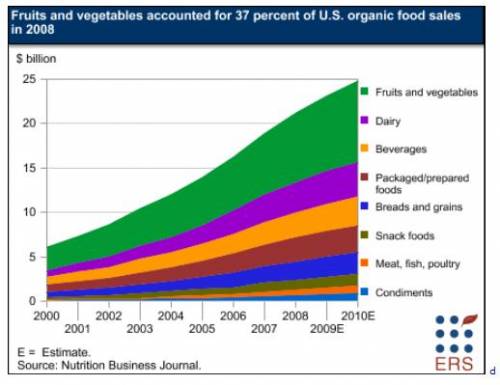
Global sales of organic food have grown about 170 % since 2002 and it reached $ 63 billion in 2011. Certified organic farms are less than 2 % of the whole farming sector and they are unable to satisfy the increasing demand for organic products. Organic products usually cost from 40 % to several times more than price for the similar conventionally grown plants.
Since on a worldwide scale the demand is higher than the supply there is a gap in the market that could be partially filled by our domestic aquaponic system .Plants grown in our system are not only organic but also a lot cheaper than those available in the shops.
Social
Organic food producers made people believe that organic products are safer for their health and taste better. Because of that people are willing to pay more for organic products than for the conventional stock. In fact, there is no scientific evidence of their beneficial impact on the human body.
However, the demand for organic foods is not only driven by concerns for personal health and for the environment. Since the ecology is very ‘fashionable’ right now people tend to improve their social status by buying bioorganic food. That also makes our product more attractive to the market.
Besides, modern society lives move at such a fast pace that every minute of the day is important. Thus, with our domestic aquaponic system people are able to get fresh herbs or plants without wasting time on shopping.
Technological
Our domestic aquaponic system can be considered as health or food gadget. It is equipped in many sensors and LCD display(?) allowing the user to monitor every parameter of the system. The main object of using technology in our houses is to save time and make life easier. Since our system is self-sustainable, it meets modern technological trends
Competition
Our main competitors are three companies offering their products online : Back To The Roots (https://www.backtotheroots.com/shop/aquafarm) , Backyard Aquaponics (www.backyardaquaponicshop.com) and Nelson Pade’s shop (www.aquaponics.com). From what we know there are no commercial producers of aquaponic systems in Europe
Back to the Roots
Back to the Roots is a U.S. company established. by a group of Berkeley students. In their online shop they offer for sale two products: one is the Mushroom Kit (to grow your own mushrooms ) and the other one is the Aquafarm which they describe as “Self-cleaning fish tank that grows food”. In fact, it is a small fancy indoor aquaponic system working similarly to our prototype.. The difference between the Aquafarm and our Aquaponic System is the use of modern technology. Our prototype is equipped with a bunch of electronic devices making our system more attractive and easier to maintain . Since the Aquafarm is the only domestic aquaponic system offered for sale worldwide, Back to the Roots is without a doubt our strongest competitor on the market.
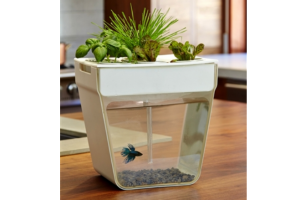
The price of the Aquafarm is 59,99$ that is equal to around 44€.
Backyard Aquaponics
Backyard Aquaponics is a leading edge aquaponics company launched in Western Australia. Initially it was just a group of people offering support and information for people interested in the subject of aquaponics. Today, the company is still a well-known provider of books, magazines and DVDs concerning the topic but it is also a rapidly developing online store offering a wide range of aquaponic systems. Backayard Aquaponics provides a worldwide shipping only for some of their products. The rest is available in their retail store located in the Western Australia.
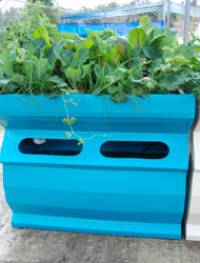
The cheapest and the smallest system offered by this company is the balcony aquaponics for 995 dolars.
Nelson Pade's Shop
Nelson Pade’s shop is a family company from USA that have been designing and researching aquaponics systems for nearly 25 years. They launched online shop in 2005 and they are still expanding product assortment. The shop does not ship their products outside of the USA.
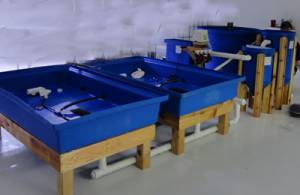
The smallest and cheapest indoor aquaponic system offered by Nelson Pade's Shop is priced at around 3000€.
4.3. SWOT Analysis
| Strengths | Weaknesses |
|---|---|
| Product is easy to use | Young and inexperienced development team |
| Using new technologies | No reputation on the market (new company |
| Self-sustainable | Limited budget |
| Eco-friendly | Limited time to develop our system |
| Plants cheaper than in the stores | Design can become unfashionable very quickly |
| Decorative modern design | Balance of the system can be easily disrupted |
| Requires little time to maintain | |
| Opportunities | Threats |
| Expansion outside the Europe | Product unacceptance on the market |
| Obtaining European Union funding | Copying (or improving) our prototype by bigger companies |
| Introducing the product to the Third World Countries | Launching a worldwide shipping by our competitors |
| Further development of the product, for example: | Healthy and ecological lifestyle trend will go out of fashion |
| * Implementing wireless connection between sensor monitoring the system and computers (e.g. wi-fi) | |
| * Producing outdoor aquaponic system | |
| * Enabling customers to customize the design of our product |
4.4. Strategic Objectives
Our marketing plan is designed to achieve the following strategic objectives in the next 3 to 5 years:
• Development of the communication module (connecting with sensors via wi-fi)
• Expansion to Asian and African markets
• Establishing and maintaining long-term customer relationships
• Obtaining European Union funding
• Introducing new design of the product in accordance to current trends
• Further improvement of our system and the company
4.5. Segmentation
To identify the target customers we divided the market into subsets of consumers who share the same or similar needs and priorities. We used criteria presented below:
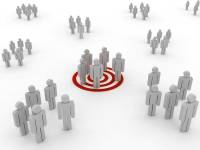
• Geographic
• Demographic
• Lifestyle
4.5.1. Geographic segmentation
There are three regions in the world where organic food production gained popularity during last 15 years - the USA, Australia and countries of the European Union. Since our main competitors are operating on the Australian and American market, we have chosen the countries of the EU as our target region. Another reason for choosing the EU countries are simplified transport procedures within the borders of the EU. As for now, the place of our production is located in one of European Union’s countries and our system will be available only to buy online so shipment duration and costs will be lower in comparison to the worldwide shipping.
4.5.2. Demographic segmentation
Demographic segmentation is performed by dividing market into groups based on:
• Age
• Income
• Lifestyle
Age segmentation
We target our product at people aged from 16 to 65. Our product is designed to use in the kitchen and to decorate the houses, thus we aim at people who run their own households or simply are able to cook.
Income segmentation
On the one hand, we aim our product at price sensitive buyers since cultivating organic herbs in our aquaponic system is cheaper than buying the same products in the store. And on the other hand we also target at people who owe extra money and are willing to spend it for exclusive house decoration or modern technologies.
Other demographic segmentation factors such as gender, occupation and education are not analyzed because of their none or negligible influence on the demand for our aquaponics
4.5.3. Lifestyle segmentation
As for the lifestyle, we aim at people that want to live in accordance to modern health and ecology trends. Our targets are also societies with rather busy lifestyle because our product is also considered as a time-saving home equipment.
4.6. Strategy/Positioning
Positioning is an essential part of the marketing strategy. Positioning is something that influences minds of the target market. It is the aggregate perception that market has of a particular company, product or service. Although the positioning of a product in people’s minds will happen irrespective of company’s activity – it will happen even if the company is passive, the certain marketing actions can have positive (or negative) impact of how our product is received by the society. Therefore, our aquaponic system must be perceived as unique on the market and satisfy the needs of the target we have chosen. To achieve these objectives we need to execute three types of product positioning related to:
• Functional position
• Position based on the consumer values
• Experiential position
Functional position
Generally, functional positions solve problems and provide customers with benefits. In the case of our aquaponic system it helps people obtain fresh herbs every day without leaving their own houses or even kitchens. This makes cooking so much easier for our customers . Additionally, overall cost of the aquaponic herbs is lower than conventional ones. This is an another measurable benefit of our product.
Position based on the consumer values
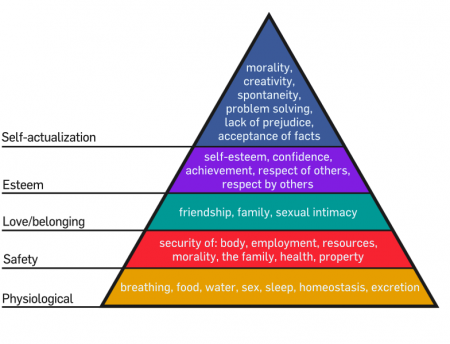 Since the second level of Maslow’s hierarchy of needs includes health and morality our product can have a relatively high value for society. The plants cultivated in our aquaponic system do not require fertilizing and are considered to be much healthier and less damaging for human body. What is more, the whole system is perceived as self-sustainable and beneficial for the environment so it is also morality need being satisfied. As for the fourth level of the Maslow’s pyramid which is respect by others, our product is very rare and new to the market so having it in the household means for the customers being unique and gaining the popularity among others.
Experiential position
Experiential position is strongly connected to sensory stimulation. If our product has an attractive and visually appealing design it positively affects customer’s sense of sight. Additionally, our aquaponic herbs have a strong impact on two other human senses which are smell and taste.
Market positioning process is also connected with positioning in advertisements. Our aquaponic system is targeted at two different segments of the market : one are people who like to cook and would like to simplify their everyday life and the other are people who would like to increase their social status by buying exclusive products that are using modern technologies. Since then, we should prepare two different advertisements approaches. As for the first segment, advertisements should emphasize that our aquaponic system is extremely helpful for cooking but also useful to save time and money. Drawing attention to always available fresh herbs and self-sustainability is our main objective for this segment. And for the second segment, our system should be presented as an exclusive, luxury product that can be used to decorate houses. In the advertisements addressed to the second target group, we should lay stress on presenting the unique design, sensors, LCD display, colorful LEDs and everything else that is connected with using modern technologies.
4.7. Adapted Marketing-Mix
To define the marketing mix for our Aquaponic System we used the 4ps tool. The questions that helped us to analyze each of the four elements are presented below.
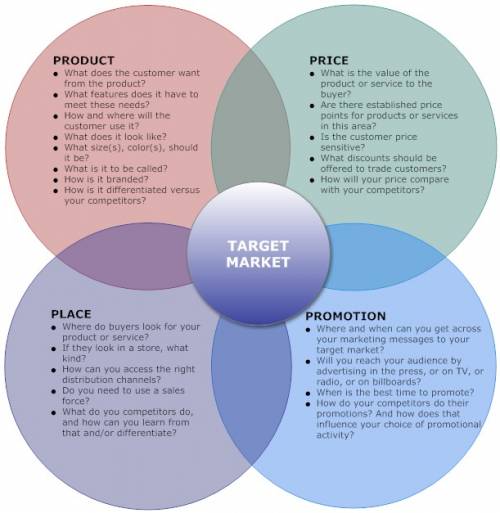
Product
The product we offer for sale is a small domestic aquaponic system designed mainly for planting herbs. Our system is adjusted to fit the typical small spaces available in the kitchen so that people could get their herbs without even leaving the room.
The layout of our system is exceptionally decorative and very up-to-date so we may consider our aquaponics as a significant element of kitchen design.
The system is also equipped with modern technologies such as sensors, programmable LEDs and Arduino controller which differentiate our system among other aquaponic systems available on the market right now. Electronic devices included make our system very self-sufficient and as much sustainable as possible.
Price
The price of our aquaponic system must cover following costs: materials, medias and tools used, labor, packaging, advertising and profit.
Defining the price at this level of product development is very inaccurate and uncertain. We are creating a prototype from the materials available only in the district of Porto so the choice of suppliers is very limited. Thus, the prices are much higher than if we could get materials online or just outside the city. Also, we are making a retail purchase so the costs are higher in comparison to wholesale prices.
At the moment, materials we ordered cost around 230 euros. We cannot estimate media, labor, packaging and advertising costs right now since we haven’t started the building process yet. The profit should be set at around 25 % of the total production cost.
Fortunately, even with the price at around 350-400 euros our product is very competitive on the market as two of our main competitors sell their product for more than 1000 dollars.
We must also keep in mind that the price will be much lower if we launch a mass production of our prototype.
Place
In the first phase of establishing our company we will focus on direct distribution channels. Therefore, we will be able to get to know customers’ needs and keep in close contact with them. We will as well do away middlemen and avoid additional costs of another layer between the manufacturer (us) and the client. By selling directly to the customers, we will be in better control of our aquaponic system‘s pricing and sales.
Nowadays, the most common direct distribution channel is the Internet. Not only it is cheap but also allows us to reach the customers located all over the world. That is why we have chosen it as our main distribution place. We will launch the Internet online store in a few different languages. To minimize the cost we will run the webpage by ourselves. For a start, we will provide a shipment to European countries but in the near future we plan to expand our activity outside this continent.
Eventually, we will also consider establishing a brick-and-mortar retail store or introducing our aquaponic system for sale in pet shops or supermarkets.
Promotion
Promoting of a product has the significant influence on the customers’ choices. Since our product will be offered for online sale, we will primarily focus on Internet advertising.
First of all, we will use the growing popularity of social media such as Facebook, Twitter etc. Creating fan page of our product and spreading the news online might work wonders for our system.
Secondly, our company will also create a YouTube account with short movies presenting how our system works and highlighting its advantages.
It is worth noting that those two advertising methods are completely free of charge.
We also noticed that blogs are becoming more and more powerful advertising channels for many different products. Therefore, we would like our aquaponic system to be widely promoted by famous bloggers. We will send them our system for free in exchange for positive reviews posted on their sites.
In the future we will also present our aquaponic system at pet or ecological trade shows and fairs. Also if we manage to obtain bigger budget we will launch radio and TV advertisements all over the Europe.
4.8. Budget
4.9. Strategy Control
4.10. Conclusion
Provide here the conclusions of this chapter and introduce the next chapter.
Chapter 5: Eco-eficiency Measures for Sustainability
5.1. Introduction
Practised in a classic way, these two productions present big economic and environmental inconveniences. The agriculture requires important contributions in fertilizer and in water, which are broadcast in the earth with a bad yield: a large part of these contributions gets lost in the ground and does not benefit the plant, causing waste and pollution. The intensive breeding of fish generates a large amount of organic waste which threatens the environment when released.
Combining these two cultures cancels out the negatives of each by working together.

5.2. Environmental
Supporting a Culture will inevitably impact the Environment
The manufacturing of media for Grow beds includes energy: for extraction of raw materials; their transformations, which often includes high heat; the packaging; transportation to the final place of sale. A lot of this energy is used as polluting fossil fuels which are very harmful for the environment (CO2, NOx, SOx,).
There is other one factor impacting on the quality of the water and the air. There is no ecological substratum, but only supports(media) of cultures, the manufacturing of which (or elimination) impacts more on the environment.
The future of the soil-less culture rests on the development of media that has little or no impact upon the environment.
The agricultural by-products of industries can establish horticultural media which is environmentally friendly: straw, linen, sawdust, wood bark, raisins and more.
These media types tend to settle gradually which reduces the aeration of roots. Some of these media types can also be unstable and could cause harm to plants as they break down. In order to find which natural media types are best it is wise to test on a large variety of plants to see different impacts.
As this type of media breaks down and creates a layer where oxygen cannot pass through more tests would be done to see benefits and negatives of this composting and weigh them against each other.
5.3. Economical
The Economical Impact of Aquaponics can be extremely large if done correctly. As with regular farming, Aquaponics requires land in order to set-up the system. Initially Aquaponics is very expensive with it's set-up costs compared to Agricultural Farming due to the need for Tanks, Piping, Media, etc. But this initial cost is reduced by larger profit margins due to Aquaponics allowing plants to grow faster and is an organic system with the plants being healthier than unnaturally fertilised plants. Couple this fast, healthy growth of plants with a large fish farm below and the Aquaponics system is a two for one.
Agricultural Farming uses around 90% more water than an Aquaponics System which has a large impact on the Environment itself. This extra use of water along with the Plants only being grown compared to Plants and Fish shows simply the benefits of Aquaponics. It increases profits by adding an extra product to sell while being more environmentally friendly in the long run.
Aquaponics is a step towards reducing food shortages within Third Worlds and hot countries. The large difference in water needed means that as long as there is an initial investment towards the structure itself the system can run for very little and provide a lot to a large group. The reduction in water allows more water to be saved for the consumer and overall provide a healthier lifestyle incorporating organic food and an increased water supply.
5.4. Social
Organic Foods are still on the rise across the world. People nowadays look to healthy alternatives to cheaply manufactured/processed foods. With the world now looking to save money and eat well it is possible by combining to forms of farming at once. Organic plants/vegetables coupled with organic fish not reared in an overcrowded farm. Knowing that what you are eating is healthy is a large part of buying the right food and with an Aquaponics system it is possible for someone to have that within their own backyard/home.
The future is Green and with the reduction of straining our natural resources. Aquaponics reduces the strain on resources by allowing the user to both breed and eat the fish within the system and grow/harvest the plants that are produced. This system is not completely sustainable but for the future it has a large reduction on key resources such as Water. Requiring only 10% compared to Agricultural Farming.
Communities can now come together to farm for themselves in first and third world countries. The impact on a community could be massive by increasing both food and water supplies and by giving jobs to many if a large farm is required or necessary. Simple Aquaponics systems can also act as a point of noticing someone's contribution to the community and be a stimulus for other Ecological adaptations within the way we grow our food and live our lives.
5.4. Life Cycle Analysis
The Life Cycle on an Aquaponics System can be very sustainable if done correctly.
With the system itself it is important to reuse components from other areas. This can include large Water Barrels reused to hold the fish; Old PVC guttering to hold the Plants and Grow Media; Bark for the Grow Media. The system should be able to be reused repeatedly for a long period of time. If sourced correctly then the component should not wear down quickly and will last an extended period of time. However after a certain period of time these materials will begin to degrade and affect the water circulating in the system which can pollute the plants and fish.
The components may then be sent to a recycling facility to be put back into the system.
Small amounts of extras must be put into this life cycle including fish food and a water supply. However the fish food can be made from natural and renewable resources.
5.4. Conclusion
Overall the Aquaponics System can possibly be very Ecologically Friendly and Sustainable. Through the correct set up and use of this system it can provide a large source of food for a community and have a small impact on the Environment. The reduction in water use a large positive from using an Aquaponics system. However the initial costs for these systems can be expensive so investment would be needed for smaller and poorer communities. In the end it is obvious Aquaponics has a large range of positives but coupled with a few negatives which can possibly put off many consumers.
Chapter 6: Ethical and Deontological Concerns
6.1. Introduction
This Chapter is to provide an overview of how Ethics and Deontology come into effect when engineering/designing products and more specifically our Aquaponics System. Across the world Ethical and Moral rules differ greatly due to differences in Laws and Personal outlooks. A product designed must conform to all Laws within the targeted market and be Ethically/Morally sound.
“Engineers invent the future and their work affects the lives of millions of people, for better or worse. That raises enormous ethical issues in every branch of engineering” [10]
6.2. Engineering Ethics
Engineering ethics is as much a part of what engineers in particular know as factors of safety, testing procedures, or ways to design for reliability, durability, or economy. Engineering ethics is part of thinking like an engineer.[11]
Why?
To prevent tragedies, disasters, and scandals in which engineers have been major players.
We need analyze key ethical concepts and principles that are relevant to the particular profession or practice. Even if there are paradigms for, say, “safe” or “unsafe,” there are areas of vagueness and uncertainly. Algorithms that do justice to the ethical issues are hard to come by. Deal with ethical disagreement, ambiguity, and vagueness. The trick is to acknowledge that some disagreement and uncertainty can be expected and should be tolerated, but to refuse to accept the view, “Everyone’s opinion is as good as anyone else’s when it comes to ethics.”
Engineering is not just a technical or theoretical enterprise. Inherent in the exercise of engineering expertise is the provision of useful, if not essential, services to clients, employers, customers, and the public. Usefulness, quality, safety, efficiency, and cost effectiveness are not secondary features of this activity. They are its heart. The engineering work is not indifferent for itself, or for the rest of society. After all, progress is the improvement of the human world, not only in the technical field, if not from a perspective that considers the quality of life.[11]
How?
Aquaponic engineers shall commit themselves to making the analysis, specification, design, development, testing and striving to increase the competence and prestige of the engineering profession. Using their knowledge and skill for the enhancement of human welfare[12]. In accordance with their commitment to the health, safety and welfare of the public, engineers shall adhere to the following Principles:

- COMMUNITY– Aquaponic system engineers shall act consistently with the public interest. Hold paramount the safety, health, and welfare of the public [12]
- Accept full responsibility for our work.
- Moderate the interests of the aquaponic engineer, the employer, the client the users and the fish.
- Approve the system only if we belief that it is safe for the users, fish and plants, meets specifications before the introduction of the fish, passing the appropriate tests, and does not diminish quality of life, diminish privacy or harm the environment. The ultimate effect of the work should be to the public good.[13]
- Disclose to appropriate persons or authorities any actual or potential danger to the user, the public, or the environment, that they reasonably believe to be associated with the system or related documents.
- Be encouraged to volunteer professional skills to good causes and contribute to public education concerning the discipline.
- CLIENT AND EMPLOYER – Aquaponic system engineers shall act in a manner that is in the best interests of their client and employe consistent with the public interest.
- Provide service in their areas of competence [12], being honest and forthright about any limitations of their experience and education.
- Not knowingly use aquaponic system that is obtained or retained either illegally or unethically.
- Keep private any confidential information gained in their professional work, where such confidentiality is consistent with the public interest and consistent with the law.
- Identify, document, collect evidence and report to the client or the employer promptly if, in their opinion, a project is likely to fail, to prove too expensive, to violate intellectual property law, or otherwise to be problematic.
- PROFESSION - Engineers shall advance the integrity and reputation of the profession consistent with the public interest.
- Ordered List ItemShall advance the integrity and reputation of the profession consistent with the public interest.
- Help develop an organizational environment favourable to acting ethically.
- Promote public knowledge of aquaponic systems engineering.
- Extend aquaponic engineering knowledge by appropriate participation in professional organizations, meetings and publications.
- Not promote their own interest at the expense of the profession, client or employer.
- Obey all laws governing their work, unless, in exceptional circumstances, such compliance is inconsistent with the public interest.
- Be accurate in stating the characteristics of system on which they work, avoiding not only false claims but also claims that might reasonably be supposed to be speculative, vacuous, deceptive, misleading, or doubtful.
- Take responsibility for detecting, correcting, and reporting errors and associated documents on which they work.
- Avoid associations with businesses and organizations which are in conflict with this code.
- Recognize that violations of this Code are inconsistent with being a professional engineer
- Express concerns to the people involved when significant violations of this Code are detected unless this is impossible, counter-productive, or dangerous.
- COLLEAGUES - Engineers shall be fair to and supportive of their colleagues.
- Encourage colleagues to adhere to this Code.
- Assist colleagues in professional development.
- Credit fully the work of others and refrain from taking undue credit.
- Review the work of others in an objective, candid, and properly documented way.
- Give a fair hearing to the opinions, concerns, or complaints of a colleagues
- Assist colleagues in being fully aware of current standard work practices including policies and procedures for protecting passwords, files and other confidential information, and security measures in general.
- Not unfairly intervene in the career of any colleague; however, concern for the employer, the client or public interest may compel engineers, in good faith, to question the competence of a colleague.
- In situations outside of their own areas of competence, call upon the opinions of other professionals who have competence in that area.
- Conduct themselves honorably, responsibly, ethically, and lawfully so as to enhance the honor, reputation, and usefulness of the profession.[13]
6.3. Sales and Marketing Ethics
Sales and Marketing Ethics are a large part in retaining customers and building a solid brand image. During the Sales and Marketing processes/Campaigns the product must be sold truthfully without tricking the consumer into buying the product/service. All marketing campaigns must be truthful when selling the product so that the customers trust the brand and will return to buy future products. With our Aquaponics system a main marketing idea is that the system is very sustainable. However we must be truthful when marketing the product and say that it is only very sustainable backed up by facts such as that it only uses 10% of the water usually needed to grow plants due to the cycling system. In many cases throughout the net Aquaponics is said to be 100% sustainable however this is untrue due to the several inputs required such as Electrical Power Supply, Fish Food, Water.
6.4. Academic Ethics
When you are doing a work or an investigation you have to take in account the following values[14]:

These values are thought to preserve the copyright. It is really important to be transparent citing the sources of information. False or misleading citations of sources constitute plagiarism.
“Plagiarism is the appropriation of another person’s ideas, processes, results, or words without giving appropriate credit, including those obtained through confidential review of others’ research proposals and manuscripts.” Federal Office of Science and Technology Policy, 1999
6.5. Environmental Ethics
It is the relationship that humans have with the natural environmental. To design the aquaponic system have to be taken in account a lot of environmental ethic aspects.
The ethical of the fish is based on the respect for the dignity of the animals. Assisting in achieving the conservation and survival of the fish must be the principal objective. To do that in the best way it is necessary:
- Meet the nutritional requirements of the fish specie.
- Clean water frequently.
- These animals breathe oxygen in the water, therefore, it is essential that they have all the oxygen they need. For that its really important the tank size.
- PH correct.
- Right temperature.
- Good light.
- Decoration. Habitat complexity plays a much larger role in shaping aggressive behaviour than most other factors.
Environmental ethics must serve to not commit next generations. We have to be responsible with natural resources that we are using. In our aquaponics system we want to use materials which can be recycled.
6.6. Liability
We are responsible for our project. It is an academic project with supervisors guiding us and we have to be clear about the objectives of our project and its purpose. For that, we have to respond with the expectations.
We must also consider our customers and respond to possible unexpected problems that may arise in our system. To define our responsibility is very important to write the warrantee, promising the good condition of the aquaponic system and the states that we are responsible for repairing or replacing the product.
With the project, we have to be careful with our work to avoid problems of copyright.
Under no circumstances the product will endanger human or animal life.
6.7. Conclusion
We will consider all code of ethics as this is essential for coexistence. Follow this code will serve to avoid confrontations or irrational disputes. Without them we would have no basis for what they imply good and evil concept of what is generally understood as good and bad actions.
Chapter 7: Project Development
7.1. Introduction
In this Chapter we will cover the Aquaponics System as both a physical object and mechanical system. We will look at the physical appearance of the system and how it is set up including all different materials/modules incorporated within the design and we will also look at how the system works within the design and how different aspects of the design affect the system's effectiveness.
7.2. Architecture
This Chapter is to present an Overview of the different aspects that go into creating the system and physical design. To get a full understanding of the System there will be Multiple drawings/CAD Models to show how the design is set up and some simple flow charts to describe the system step by step within the design.
7.2.1. Initial Design
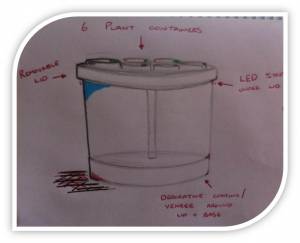
Our Initial Design was aiming to be sleek and simple so that it wouldn't be intrusive to have within the kitchen or home. We looked at current designs and thought about what we knew about fish tanks. The classic Goldfish bowl was a large influence on the original design as it was simple. Also, coming from s design background it was key to follow current trends of modern styles which include organic shapes that have no sharp edges. This is where the cylindrical shape came into the design as it gave more space than the bowl. The tank being cylindrical meant that the Grow Bed should be the same shape to be easy on the eye.
In order to draw focus to the main aspect of the system being the fish within the tank two strips of plastic/veneer covered the base and grow bed. This would outline the tank and draw the eye to this area. Finally as we want the system to be technological and appealing to all consumers we decided to add LED strips to under the Grown Bed to add an extra focus to the tank. The LED's could change colour and cause different effects on the tank. The Grow Bed would almost completely cover the plant pots so just to see the plants themselves growing from the system. The pots would be arranged in a circle around the centrally placed pump, ensuring equal spreading of nutrients/water.
7.2.2. Grow Bed Pots
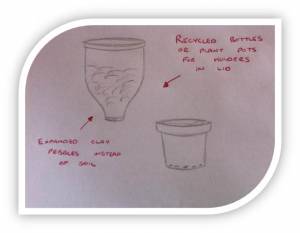
The pots used to hold the media and plants was initially thought to be a reused product such as glass or plastic bottles that have been cut down to correct size. These bottles could of added an aesthetic look to the top of the Bed. A rubber coating was to be added to the cut edges of the bottles to ensure safety while handling. We found this to be an interesting style and possible simple solution
Simple Plant pots then became the main focus of our idea. As the design itself developed so did the idea of using bottles as pots. The process of just reusing plastic plant pots instead of cutting your own with the rubber dipped edges was a lot smarter and simpler. It also allowed the plant pots to be reused before being recycled. Glass bottles with a rubber element would have been much harder to recycle and this idea was taken out.
The Plant pots will follow the shape of the Grow Bed as to fit tight to one another in order to create a garden/lawn effect.
7.2.3. Development
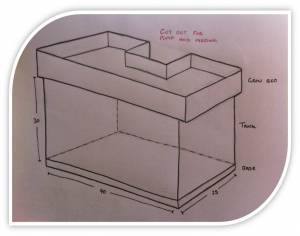
The Development of our main idea came quickly through the Research stage of our project. We found that it was unethical to use a cylindrical tank for fish and although there are many on the market we decided it was better to think about the fish's well-being and cause as little stress as possible. We decided upon a cuboid as our tank body as this is the most commonly used on the market today and other options would be too hard to create.
Through development we found that the cuboid tank would offer more water due to it's corners whereas the cylinder did not have these. This also improved the well-being of any fish kept within the tank as fish prefer a large body of water to swim freely. It also meant that we could possibly add an extra fish to the tank as we are limited with space.
The change of shape provided a stronger base for the tank but produced weak spots at the corners. This would be tackled by metal supports hidden behind the veneer/plastic strips that would wrap around the base and top just as in the cylindrical design. The design is almost the exact duplicate bar the main body shape change.
The design would still incorporate the LED strips around the under side of the Grow Bed for aesthetic appeal.
The Grow Bed design now follows the shape of the cuboid tank apart from an area taken out the back middle section. This was to allow the pump to sit in the middle of the tank and to allow feeding of the fish with ease. This area will often be covered from view by the plants growing within the Grow bed and does not take anything away from the physical appearance of the tank itself.
The debate of using a Stand Pipe, Syphon or simple drainage system and how to ensure even flow of water throughout Grow Bed are the two main debates with the Design.
7.3. Components
If we want to be successfully with the aquaponic system we have to check the water temperature and pH. Therefore, we will need an electronic system. It will be composed with the following components:
7.3.1. MOTHERBOARD
The motherboard will be the Arduino Duemilanove because we can program the microcontroller with the free Arduino software. The board can operate on 5V. Furthermore, it has 14 digital pins that can be used as an input or output and they operate at 5V.Also, Duemilanove has 6 analog inputs. Additionaly some of the digital and analog pins have speciality functionality.

Arduino Duemilanove Model: ARDU-0004

7.3.2.LCD SCREEN
A basic green LCD screen is the best option for our prototype because it is easy to use with Andruino and have cheap price. I will be connected to the power supply (5V) and to Arduino.


LCD Module 16×2, Black on Green

7.3.3.TEMPERATURE SENSOR
Temperature Sensor with the reference DS18B20 is the best option because it is waterproof and the temperature range that it checks is far enough.The sensor will be powered by data line to the Phidget Interface Kit 8/8/8 Model: PHD-1018_2.

Temperature Sensor - Waterproof (DS18B20)


7.3.4.CONTROL SENSORS INTERFACE
The control sensors interface will be used thinking about the future of the project and the measurements stability. Phidget will let us connect more sensors. It is used to measure continuous quantities. Furthermore, it provides 8 analog and 8 digital inputs. We will connect to the interface the temperature and the pH sensor. After the Phidged will be plug to Arduino.

Phidget Interface Kit 8/8/8 Model: PHD-1018_2

7.3.5 pH SENSOR
The ASP2000 pH sensor is good for our project because it measure acidity from 0 to 14. Additionally it is economic and resistant due to the epoxy body.

ASP200-2-1M-BNC pH Lab Electrode

7.4. Functionalities
7.5. Tests and Results


7.6. Conclusion
Provide here the conclusions of this chapter and introduce the next chapter.
Chapter 8: Conclusions
8.1. Discussion
Provide here what was achieved (related with the initial objectives) and what is missing (related with the initial objectives) of the project.
8.2. Future Development
We can imagine the development of a bigger system for an industrial use. The development of a special system sea water to improve the current farms of fishes at sea which are polluting and destructive. We can couple the aquaponic system with the swimming robot, the robot would be a “big sensor” to get back several types of information in the aquaponic system.[15]
Bibliography
Example: [n°] Author, Website name, URL, Year, Month, Accessed in x month 2014.
[1] Name, Title, Year. http://ieeexplore.ieee.org/stamp/stamp.jsp?tp=&arnumber=6650186 [Accessed 07/04/2014]. PDF.
[2] http://smallbusiness.chron.com/product-positioning-strategy-3350.html [Accessed 28-31/03/14]
[3] http://en.wikipedia.org/wiki/Maslow's_hierarchy_of_needs [Accessed 28-31/03/14]
[4] http://smallbusiness.chron.com/examples-positioning-strategy-marketing-10166.html [Accessed 28-31/03/14]
[5] http://en.wikipedia.org/wiki/Positioning_(marketing) [Accessed 28-31/03/14]
[6] http://en.wikipedia.org/wiki/Organic_food [Accessed 28-31/03/14]
[7] http://www.reportlinker.com/ci02035/Organic-Food.html [[Accessed 28-31/03/14]
[8] https://news.wsu.edu/2013/10/21/personal-and-social-concerns-motivate-organic-food-buyers-study-offers-tips-for-green-advertising-strategists/ [[Accessed 28-31/03/14]
[9] http://naturalresourcereport.com/2009/09/chart-organic-growth-by-food-group/ [Accessed 31/04/2014]
[10]http://raeng.org.uk/societygov/engineeringethics/pdf/Engineering_ethics_in_practice_short.pdf [Accessed 5/04/2014]
[11] http://vn.docsread.com/tw_files2/urls_3/128/d-127621/7z-docs/1.pdf [Accessed 5/04/2014]
[12] http://www.nspe.org/resources/ethics/code-ethics#sthash.NHHsW0Ze.dpuf [Accessed 5/04/2014]
[13] http://www.acm.org/about/se-code [Accessed 5/04/2014]
[14]http://cea.uprrp.edu/wp-content/uploads/2013/10/Dra.-Snejanka-Penkova.-Etica-de-investigacion-27.09.13.pdf [Accessed 5/04/2014]
[15] https://www.backtotheroots.com/shop/aquafarm [Accessed 03/04/2014]


